
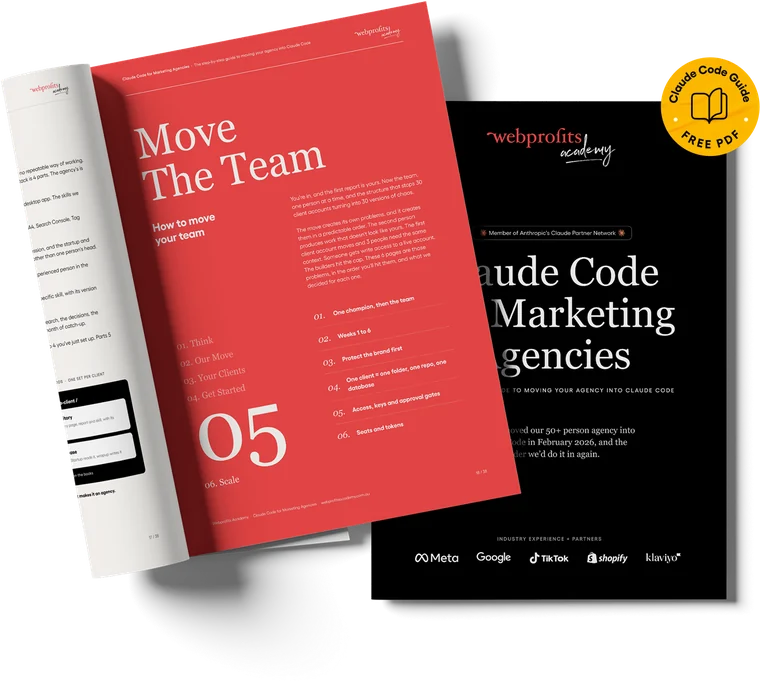
How we moved our 50+ person agency into Claude Code in February 2026, and the order we'd do it in again. You first, then one champion, then the team, then the business model.
Brands we've worked with


















This playbook is for the person who owns the agency, or runs it day to day, and has live client accounts to answer for. The Claude Code for Marketers Playbook is the map of the system. This one is the order you move an agency onto it.
On the first Monday in March, 50+ people were in terminal. By the Wednesday, every report had gone out. Not a pilot. Not a trial team. By about week 6 the team was thanking us for it.
Which client accounts go first. Who gets write access to a live account. What you charge when a report takes 5 minutes. Not one of those is a tooling question, and only the founder can answer them.
The competitor now is everyone who thinks they can do this in-house. If your team does it manually and a client gets Claude Code, you lose that client. Not because they're better at marketing. Because they've seen what fast looks like.
Every part is the problem the previous one creates, in the order you'll hit it on live client accounts.
Why the agency model is shifting, why Claude Code is what's shifting it, and why the pressure to change is already coming from your clients.
The decision, what we figured out in the order we figured it out, how a day on a client account runs now, and what changed department by department.
The 9 things a client of an agency on Claude Code gets, in the order they notice them, and a month on the account from their side of the table.
You, alone, on your own accounts, for a fortnight. The first report, and the 6-part agency stack you set up without noticing.
One champion, then the team. Weeks 1 to 6, protecting the brand first, one folder, one repo and one database per client, access and approval gates, seats and tokens.
Skills: few, built by your best. Where the money goes when you stop billing time. Hiring for judgement. Winning the next client with a built page instead of a deck.
Day 1 install and connect your own accounts. Days 2 to 3 the first report. Week 1 your own brand. Week 2 one champion. Then the structure, then everyone else.
Token cost. Client data. Whether clients will do it themselves. Whether the team will resist. Whose IP it is when a client leaves. Whether Webprofits will compete with you.
The training, the Skills Library, the playbooks and the live sessions, mapped to the parts of the playbook you'll use them for.
Free. 38 pages. Yours straight after the form.
Read it in an evening. Then do day 1: install it, connect your own accounts and start the first report.
You first, then one champion, then the senior people, then everyone else. Why that order, and what each step feels like.
Connect the accounts, build 2 skills, ask for a monthly report across every channel, correct it until it's your standard. The entire stack, set up without noticing.
The marketer's 4 parts (terminal, connectivity, memory, skills) plus a repository and a database per client. Why 30 clients can't share one folder.
Protect the brand first. One client = one folder, one repo, one database. The approval line in every CLAUDE.md file before any write access goes on.
What you charge when a report takes 5 minutes, who you hire when Claude is the junior, and how you pitch with a built landing page instead of a deck.
Week 1 is uncomfortable. Weeks 2 to 3 are the argument. Weeks 3 to 4 it turns. Week 6 is the thank yous. Plus the 2 rules that carry a team through the middle.
"It's not a tooling decision. It's a structural one, and only a founder can make it."
Claude Code for Marketing Agencies · page 2
No coding experience required.
Owners, directors and the people who run delivery day to day, with live client accounts to answer for. No coding experience required.
The structural decisions in this playbook are yours: which accounts go first, who gets write access, what you charge. Nobody else in the building can make them.
You'll run the rollout: the one-on-one installs, the champion, one folder, repo and database per client, the approval gates, the seat caps.
The people who know what good work looks like on a client account. You go in before the juniors, and the playbook says why.
Enter your details and we'll email you the link to the 38-page PDF.
Free. No call, no pitch, no card. The playbook is yours either way.
Yes, and we use it for marketing. Nobody who runs Claude Code at Webprofits is a developer. We're a performance marketing agency running Meta, Google, Klaviyo, TikTok and SEO across dozens of live client accounts, and the entire agency runs on it. You type plain English into a window and kick off real client work. No coding experience required.
That playbook is the map of the system: the terminal, memory, connectivity and skills. This one is the order you move an agency onto it. You first, then one champion, then the team, with a repository and a database per client, the approval gates, seats and tokens, and what changes about pricing, hiring and winning clients once production is instant.
It covers the WHY, the WHAT and the ORDER. The installs, the connections, the memory setup and the skills are taught step by step inside Webprofits Academy, and the last pages tell you exactly what's in there for an agency: the training your team goes through, the Skills Library you run on client accounts, and the live sessions every week.
We're not competitors. The market is our competitor, and it's everyone who thinks they can do this in-house now. Webprofits is a boutique agency by design, selective about who we take on. The clients we want come through our own funnels and lead gen systems, so we're not competing for yours. No white-label work. The Academy exists to teach, not to feed the agency, and we'd rather see the standard of marketing go up across the board than keep the playbook locked inside our 4 walls.